
Teams
Leadership, best practices and feedback: three themes, one full day of games, stories and honest conversations.
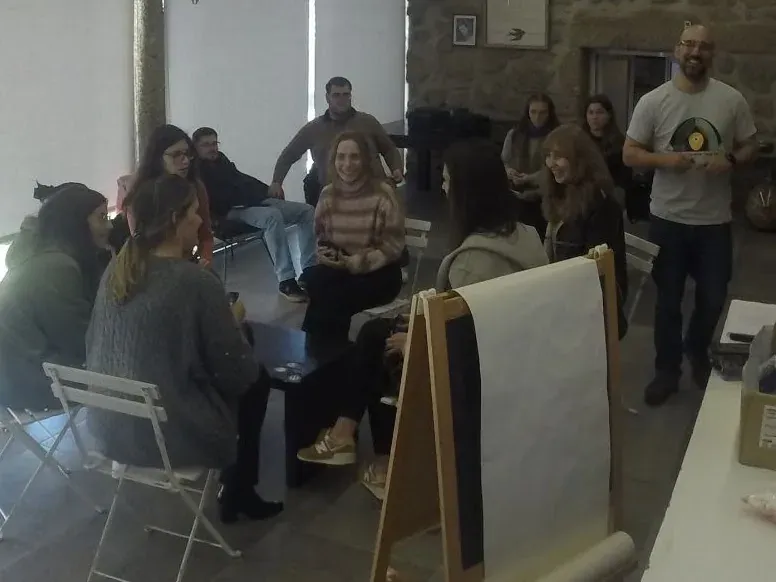
One full day
Three themes, one day
Leadership, best practices and feedback aren’t three separate trainings: they’re three sides of the same team. That’s why they are covered together, in a full-day workshop, with the whole team in the room.
The day mixes games, real stories and open conversation. Nobody gets a lecture on what a good team looks like: every game ends with a debrief on what happened, what it means for the team and what changes on Monday morning, so the team reaches its own conclusions.
Each day is shaped around the team in it. Below is a taste of each theme and a few of the games and stories it can use, then the wider toolbox a day can draw on. How the games work stays a surprise: half their value is not seeing them coming.
- 1full day
- 3themes
- 90games and stories to pick from
Who leads?
Leadership
A leader is useful, but not indispensable.
Does a team need someone in command? How far can it trust, and how far must it check? We look at what a leader really adds, what happens when nobody holds the wheel, and why the best leaders make people feel safe rather than watched.
Fewer slides, more evidence: the team puts its own theories about leadership to the test, then compares notes with a few well-known stories.
On the table
- Do we need someone in command?
- Intent-based leadership
- How leadership emerges
- Performance vs. trust
- Speaking up to the captain
A few of the games and stories
- Team game
The LEGO Build
Small teams build something together. What matters is how they get there: who ends up leading, and how much depends on communicating well.
- Game
The Mind
Puts the room's theories about what a team needs to work as one to the test, starting with what a leader really adds.
- Story
Turn the Ship Around
What happens when a captain stops giving orders: intent-based leadership.
- Story
United Flight 173
A crew so absorbed in one problem that a bigger one went unsaid, and why airlines changed how crews train.
- Story
Navy SEALs: performance vs. trust
Why the best teams pick trust over raw performance, while most companies only ever measure performance.
What works?
Best practices
Trust is built one coffee break at a time.
What does a team need to work? Everyone in the room has an answer, and they rarely match. We start there, then look at communication, perception and the habits that turn a group of talented people into a team.
Expect a few uncomfortable truths too: a team that works isn't always a pleasant one, companies often reward their stars over their teams, and what matters most is built slowly, every time someone asks a colleague for help.
On the table
- Extreme alignment
- Social cohesion
- Stars vs. teams
- Communication & perception
- Knowing yourself
- Create a safe environment
- Increase communication
- Increase trust
- Increase happiness and team performance
A few of the games and stories
- Quick share
What makes a team work?
Brings out what the room believes matters most for a team, contradictions included.
- Quick game
Perception check
A short reminder that communication helps, but perception gets in the way.
- Team game
Who gets to talk?
Makes each person aware of how they take part in a conversation, and how others do.
- Team game
Untie the Knot
Teamwork and coordination, and a great warm-up for a feedback round afterwards.
- Team game
Flip It Over
Creative problem-solving where the team only succeeds if everyone does.
- Reflection
Know yourself
Personality preferences, not as a box to put anyone in, but as a way to talk about different motivations, styles and preferences.
How we talk
Feedback
There is no failure, just feedback.
Most teams give each other feedback, yet few ever stop to really talk. We look at the difference between feedback and evaluation, why criticism so easily turns personal, and why avoiding conflict can hurt a team as much as a fight.
It ends in practice, not theory: the team tries it for real, in a safe space, and leaves with a way to keep doing it.
On the table
- Feedback vs. evaluation
- Unhealthy peace vs. unhealthy conflict
- Ask for feedback, don't wait for it
- Speak from the "I", not the "we"
- Describe the behavior, not the person
A few of the games and stories
- Group exercise
Feedback or evaluation?
Shows what constructive feedback looks like, and how easy it is to slip into judging people instead.
- Story
The failure party
A games studio that celebrates its flops, and what it gets out of them.
- Story
Don't punish the behavior you want
Why a well-meant "finally!" can undo the very change you asked for.
- Story
Harder to be kind than clever
A lesson Jeff Bezos got as a boy, about the cost of being right.
To keep the conversation going after the workshop, LoopGain: Teams turns feedback sessions into a card game.
Discover LoopGain: TeamsPick and mix
The toolbox
More games and experiments to pick from.
Beyond the core of the day there's a wider toolbox: social experiments borrowed from psychology and behavioral economics, and shorter games to wake a room up, get people talking or have them decide together. Each day picks from it, depending on what the team needs.
Same rule as above: what they are called and what they are for, never how they run.
Social experiments
Classic experiments, turned into something a team can live through and then talk about.
Trust & cooperation
When it pays to cooperate, and why trust breaks so easily.
- The Goldfish GameThe tragedy of the commons: how sensible individual choices add up to a collective disaster.
- The Ultimatum GameFairness vs. pure logic: why people turn down a gain that feels unfair.
- The Red/Blue GameCooperation vs. betrayal, and how fragile trust is when winning comes at someone else’s expense.
- The Prisoner’s Dilemma TournamentThe strategy that wins over time, and what it says about working in a team.
- The Public Goods GameIndividual vs. collective interest, and why teams need norms so everyone carries their weight.
- The Lemonade StandCompetition, price wars and collusion, and why cartels tempt but rarely hold.
- The Pareto TradeNegotiating for win-win: creating value instead of just claiming it.
- The Dollar AuctionIrrational escalation: why we keep paying just to avoid a loss.
- The Trading GameThe endowment effect: why we overvalue our own ideas and struggle to kill a failing project.
Groups & decisions
How groups decide, and how they agree on something nobody wanted.
- The Abilene ParadoxGroupthink: going along to get along, even when nobody wants to go.
- The Abilene DestinationCatching groupthink early, and why a team needs a devil’s advocate.
- The Asch ExperimentThe power of conformity, and the courage it takes to be the lone dissenting voice.
- The Information CascadeHow a group reaches the wrong conclusion even when its people have good information.
- The Silent RankingA better way to brainstorm, where silence becomes a tool.
- Lost at SeaThe wisdom of the crowd: when a group is smarter than any one of us.
- Desert SurvivalConsensus vs. majority: does the team use what it knows, or follow the loudest voice?
- Survival on the MoonWhether a team can get past expert intimidation and hear every voice.
- The ShipwreckDeciding together under pressure, and the hidden values behind the choice.
- The Trolley Problem, liveMoral intuition: how our logic shifts as things get personal.
Power & leadership
What power, structure and resources do to the people inside a system.
- StarPowerInequality and power: how they change behavior and motivation.
- The King’s CourtArbitrary power: how quickly people adapt to a hierarchy, and how it changes them.
- The Blind PolygonLeadership and mental models: reaching a goal when nobody sees the big picture.
- The Trust BatteryHow transparency, or the lack of it, affects speed and quality.
- The MinefieldPsychological safety and trust between the one who guides and the one who does.
- The Success LadderThe Matthew effect: how a system can make people look untalented when they are just badly placed.
- The Scarcity SimulationCognitive load: what an overworked team loses, beyond time.
Communication & silos
What gets lost between people, layers and teams.
- The Color BlindPrecision of language: building words that mean the same thing to everyone.
- The Zome ConstructionThe mental model trap: why a team needs a shared vocabulary before it starts.
- The Silent BuildThe silo effect: how perfect work in every team can still add up to failure.
- The Telephone DrawingHow a vision gets distorted on its way through the layers of an organization.
- The Broken SquareEmpathy and observation: success means looking at what the whole group needs, not just your task.
- The Five SquareCollaborative vs. competitive mindsets: a team isn’t done until everyone is.
Bias & perception
How what we expect shapes what we see, and how others see us.
- The Labels PartyExpectation and bias: how labels and social cues shape confidence and behavior.
- Robbers Cave, liteTribalism: how quickly an “us vs. them” mindset takes hold.
- The Invisible GorillaSelective attention: we don’t see the world as it is, we see what we look for.
- The Liar’s ConfidenceThe illusion of transparency: the gap between how we feel and how we come across.
Teams at work
What great teams do differently while they work.
- The Marshmallow ChallengeIteration vs. planning: why prototyping beats theory.
- Marshmallow vs. SpaghettiThe vulnerability loop: why owning up to mistakes fast beats being polite.
- The Rope PullSocial loafing: why effort drops as a group grows, and how visible contributions help.
Shorter games
Quick ones, to open the day, change its pace or warm up for what comes next.
Energizers
To bring everyone into the room, at the start or after lunch.
- Keep up the Balloons
- Alternative ApplicationCreative thinking
- Paper Plane ParadeTeamwork, creative thinking
- Word AssociationQuick thinking, communication
- Caption ThisCreative thinking, collaboration
- Emoji QuizCreative thinking, problem-solving
- Ninja
- FrustrationStaying calm under pressure
- Pirate’s Treasure
- Stop-WalkListening skills
- Lightning Scavenger Hunt
- Guess the Emoji Board
Communication
Listening, observing and making yourself understood.
- ClassificationGetting to know each other
- Sneak a PeekObservation, communication
- Who am I?Communication, problem-solving
- Show and TellPublic speaking, communication
- Copy CatListening, comprehension
- Quiz Question of the WeekGetting people to interact
- Blind RetrieverListening, communication
- 3-Question MingleGetting to know each other
- The Communication GameCommunication, observation
- Blind DrawingCommunication, observation, listening
Trust
To get to know each other a little better.
- Two Truths, One Lie
- Pen Pals
- Bucket List
- Team Trivia
- Draw Your MoodExpressing moods
- Silver LiningsMindset, positivity
- Personal User ManualsOnboarding, company culture
Deciding & solving
Making decisions and solving problems together, often against the clock.
- The One Question GameCommunication, decision-making
- This or ThatCommunication, decision-making
- Birthday Line-upProblem-solving, communication
- Paper TowerProblem-solving, collaboration
- Swedish StoryPublic speaking, deciding fast
- Paper ChainsCommunication, problem-solving, leadership
- Balloon in WaterSolving problems with limited resources
Your team
Bring it to your team
Each day is shaped around the team in it: its size, its moment and what it needs most. Tell me a bit about yours.
Curious? Fill in the form below and let's talk 🙃
Note: if you work at a non-profit or a school, I'm happy to do this pro bono.